

Links
Next content
Read more
Understanding Cyber Risk: Drivers and Impacts on Firms
This paper examines the firm-level determinants and financial consequences of cyberattacks using a dataset that combines survey data from the Bank of Italy with firm balance sheet information from Orbis (2014-2022). We employ panel...
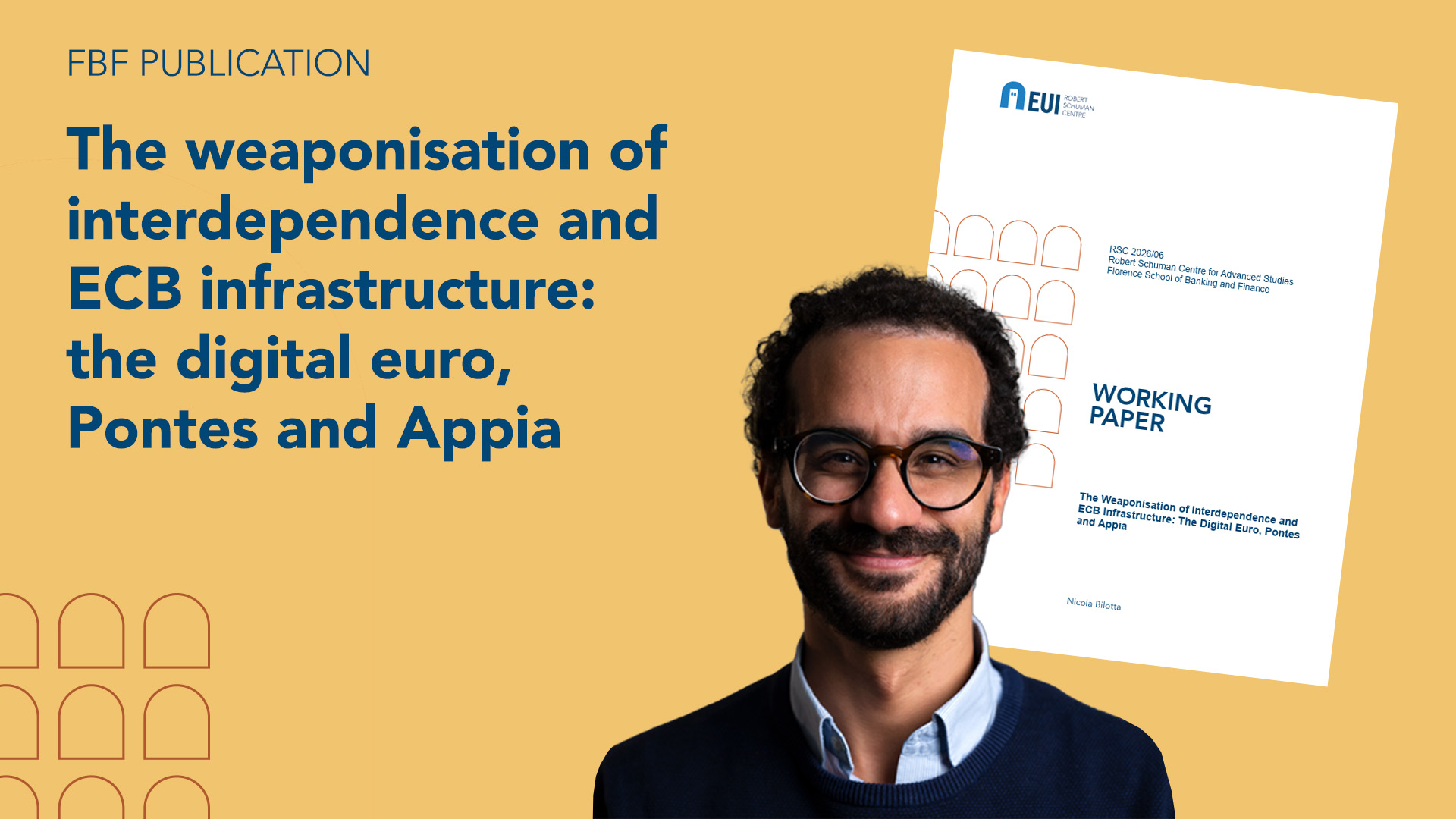
As geopolitical tensions have intensified concerns about payment infrastructure dependencies, the European Central Bank (ECB) has accelerated work on two parallel initiatives: a retail Central Bank Digital Currency (rCBDC), the digital euro; and a wholesale CBDC, the two-track Pontes and Appia projects. This article asks what factors account for the divergent institutional and technical design configurations of these projects and what this variation reveals about how weaponisable dependencies operate across domains and stages of consolidation. Drawing on Farrell and Newman’s Weaponisation of Interdependence (WI) framework, this study conducts a design-level examination of technical specifications, governance arrangements and procurement rules drawn from ECB documents, project reports and institutional publications. The article proceeds in two steps. First, applying Farrell and Newman’s three-condition test, it establishes that the EU retail and wholesale payment domains each satisfy all three conditions for weaponisation – network centrality, foreign jurisdictional control and high switching costs – but at different stages of dependency consolidation. Second, it extends the framework by applying it at the design level. It maps how the design features of the digital euro and Pontes-Appia correspond to these conditions. The findings show that the digital euro exhibits features consistent with addressing entrenched dependencies, while Pontes and Appia are configured to pre-empt prospective vulnerabilities associated with emerging dependency configurations. These findings demonstrate that the stage of dependency consolidation helps explain divergent infrastructure design configurations and they identify infrastructure design as a strategic tool to manage structural dependence.