

Links
Next content
Read more
Order in disorder: a research compass on the geopolitics and geoeconomics of finance
The global economic and financial system is under pressure as geopolitical competition, economic security and technological change increasingly shape international interdependence. This paper provides the conceptual foundations and research compass of the GeoFinance Lab,...
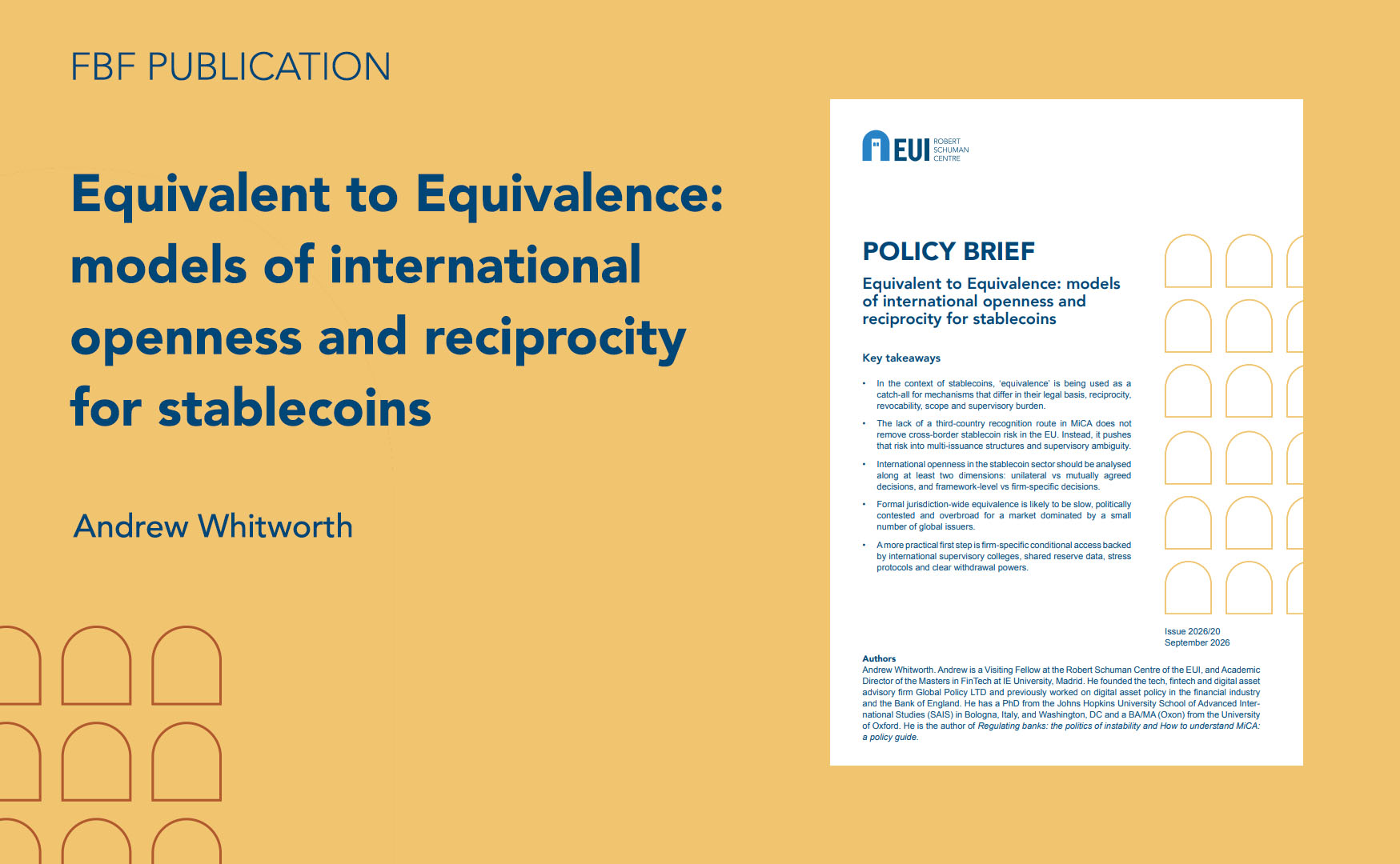
Stablecoin regulation is national while stablecoin activity is cross-border. There are currently few mechanisms to support cross-border regulation and supervision. The resulting debate is often framed as a search for ‘equivalence,’ but equivalence is only one model of international openness. This brief distinguishes between unilateral and mutually agreed approaches, and between framework-level and firm-specific decisions. It argues that formal jurisdiction-wide equivalence is a poor default for stablecoins. It is slow, politically charged and often too broad for a market dominated by a few global issuers. A more realistic near-term route is firm-specific conditional access supported by international supervisory colleges, shared reserve monitoring, information sharing and clear crisis protocols.