


Read more
Savings and Investments Union Lab (SIU Lab)
Launched in 2026, the Savings and Investments Union Lab (SIU Lab) aims to support the development of a more integrated and effective European Savings and Investments Union. The initiative seeks to contribute to the...
This week, two events brought together scholars, policymakers, supervisors and market participants to discuss the European Union’s Savings and Investments Union (SIU), examining both its wider political and social implications and the strategic priorities needed to deepen Europe’s capital markets.
Strategic priorities for EU capital markets
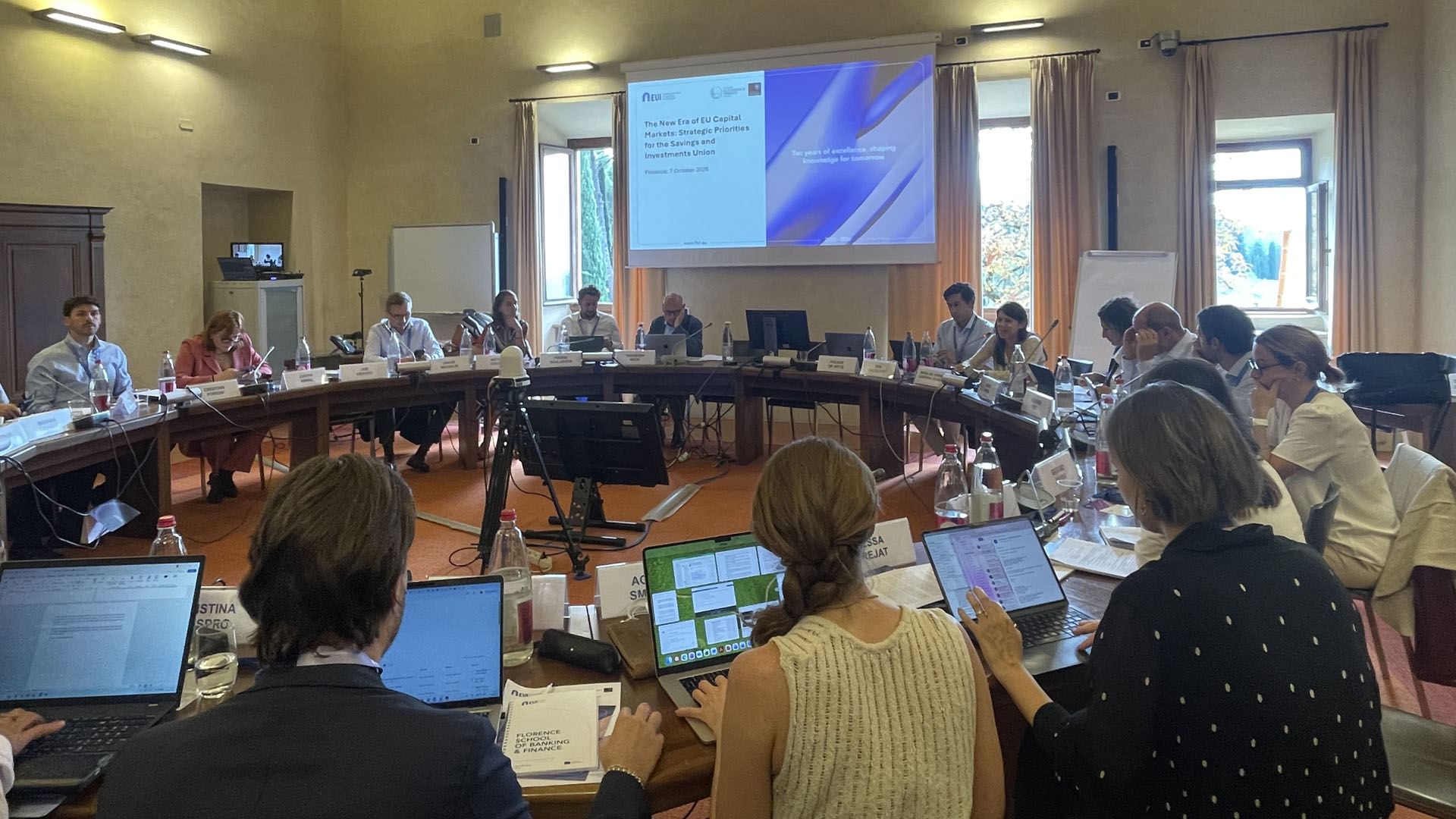
On 7 October, an executive roundtable focused on the strategic direction of the SIU ahead of the European Commission’s Q2 2027 mid-term review. The roundtable was organised by the Florence School of Banking and Finance together with the Oxford Sustainable Finance Group at Oxford University, as part of the Savings and Investments Union Lab.
The discussion started from the barriers that still constrain capital market integration, including fragmented legal frameworks, nationally embedded supervisory practices, limited venture capital and scale-up channels, and high post-trading costs, and asked how far the measures now on the table will remove them.
Ahead of the review, participants examined what simplification through a stronger single rulebook and more integrated supervision can deliver, what the securitisation reform can realistically change, and the conditions the SIU will need to meet to support European competitiveness, strategic autonomy and the sustainability transition.
The conversation resumes in Oxford in 2027, with the review in hand, to ask what it has settled and what it has left for the next phase of the SIU.
An interdisciplinary perspective on the Savings and Investments Union
On 8 October, an interdisciplinary workshop organised by the EUI Finance and Society cluster considered the SIU as more than a technical financial initiative. Bringing together perspectives from law, history, political economy, political science, public policy, political science and economics, participants explored how the strategy could mobilise private savings and support the green and digital transitions. They also addressed broader questions of governance, democratic legitimacy, social inequalities and the evolving relationship between citizens and financial markets.
By fostering dialogue across disciplines and between academia and policymaking, the workshop aimed to develop a richer understanding of the SIU as both a financial integration project and a broader political and social transformation that is impacting European societies.
Together, the two events highlighted the SIU’s multiple dimensions, connecting the practical challenges of financial integration with the wider political, institutional and societal changes shaping its development.